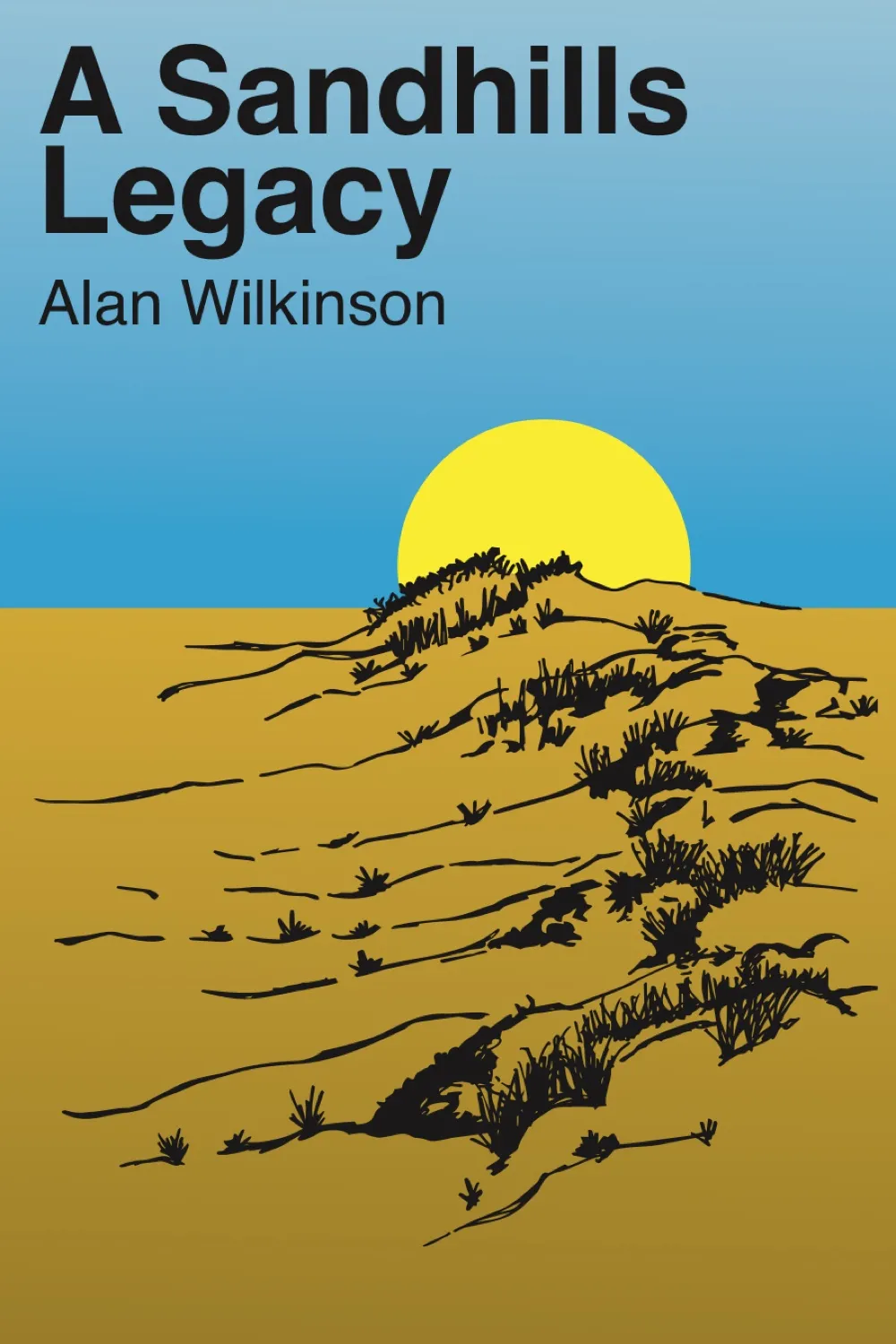
A Sandhills Legacy
North Dakota State University Press, 2026
When Steve Kaminski realised that the man who raised him wasn’t his father, he left the family’s Nebraska ranch in a rage. That was 45 years ago, and he’s never been back. Now he gets a call from his sister. She’s dying, and wants him to help her spend her remaining days in the house they once called home.
Academic Lyn Collier is on the crest of a wave. With a book deal in her valise, she’s heading to Nebraska to complete the work she started twenty years ago, a study of Mari Sandoz, daughter of a Sandhills pioneer and author of such books as Crazy Horse, Cheyenne Autumn and the biography of her own father, Old Jules.
Stranded in a frontier-period hotel by a spring blizzard, these two characters find their past and present lives intertwined as they seek the truth about Steve’s family and Lyn’s literary heroine.
While exploring the dynamics of memory, conflict and reconciliation, A Sandhills Legacy also celebrates the unique landscape of the Nebraska Sandhills region, and the shadowy life of its most famous daughter.
Coming soon
Read an extractExtract
An extract from A Sandhills Legacy
A ROUND TEN O’CLOCK on a sunny Monday morning in April 2011, in a small town in eastern Oregon, Steve Kaminski checked his watch, stowed his electric jigsaw in the back of the truck, and strolled across the forecourt of the Thunderbird Motel, emerging onto Main Street. From there he walked three blocks to the Western Union office where he collected a large sum of cash. Sitting on a cheap plastic chair, he peeled off fifty twenty-dollar bills and tucked the rest down the front of his denim shirt. Back at the window, he wired the thousand to an address in Portland. That would keep the vultures off his back for a few weeks.
Across the street, he entered the family-run diner where he got breakfast most days. He ordered his usual eggs over easy, wheat toast (no butter), and bacon. He sat for some time over his coffee, absorbing the feeling of deep ease that had spread through his body. When the owner came by with the refill, she asked him what his plans were for the week.
“Nothing much,” he said. “Might take a little trip. Might not.”
“Sounds like a plan,” she said, and moved on to the next table. She knew better than to quiz him.
From the diner he made his way to the thrift store. By eleven o’clock, he was back at the place he’d called home for longer than he cared to recall. Turning the key in the door marked 109, he entered a sparsely furnished room, approached the bed, moved the neatly folded Navajo rug to one side, and sat down. He took out the money, four bills at a time, folding a fifth over each bundle, just the way they’d showed him when he worked at the race course all those years ago.
He slipped two hundred into his billfold, the rest into the beige nylon fanny pack he’d just bought for a dollar fifty, the previous owner a smoker by the smell of it. It felt odd when he fastened it around his waist. Reassuring, but odd. It wasn’t a thing he’d ever used before.
As to the sensation of closing his hands around the fat wad of bills, that would stay with him for some time. Four thousand bucks, near enough. He hadn’t had his hands on so much cash in years.
He shifted the bulge ’round to the small of his back where his quilted jacket would hide it from view. Just to make sure, he stood up and twisted his neck to check in the mirror. Then he opened the door and stepped out into the yard, sliding a hip flask from his pocket and taking a quick swig. It was a chilly morning, despite the sunshine.
He walked across the gravel toward his truck, opened up the tailgate, and took out a small, rectangular double-glazed panel. He held it against the matching hole he’d cut in the freshly painted plywood shell, and eased it into position. It fit snugly. It took him but a couple of minutes to work the rubber seal into place around the edge. When done, he stood back, squinted at it, and nodded approvingly.
A few yards away, Wayne was standing at the office door with a cup of coffee in his hand. “Gotta say you’re doing a hell of a job there,” he said.
Steve reached out and wiped a smear of dirt off the glass with his shirt cuff. “Yeah.” He turned to face his employer. “I’ve had a whole lot fancier campervans, but this one comes cheap. Got all my materials outa your dumpster there.”
“Is that a fact?” Wayne walked across and peered into the back of the truck. There was an old wooden tool chest, a mattress, and a pile of folded blankets; above them, a set of little wooden drawers that Steve had fashioned out of reject lumber. A couple of cast-iron pans and a large enameled mug hung from hooks set in the roof. “Looks real cozy,” he said.
“Needs to be,” Steve said. Shielding his eyes against the sun, he looked at the snow-covered mountains, barely five miles distant. “No telling what the weather’s gonna do this time of year.”
Wayne paused, then asked, “So, any chance you’ll come back—after you’ve finished in . . . where’d you say, Nevada?”
“Nebraska. For chrissake.” Steve turned to look at him. How many times did he have to say it?
“Yeah. Well, the offer still stands.”
“Listen,” Steve said, “I blew into your yard looking for a place to stay the night. The night. Remember?”
“Sure I do. Damned truck woke me up, coughing and barking like a sick dog.” Wayne waited a moment, then added, “You weren’t too clever yourself.”
“That was then.” Steve flicked a bug off his wrist. “Hell, I ain’t stayed this long in one place since . . .” He shook his head. He’d said enough.
Wayne wiped his lips with the back of his hand. “What about Lois?”
Steve knew he didn’t need to answer that. It was none of the guy’s damned business. He picked up a second glazed panel and took it around the far side of the truck. Wayne followed, watching him as he slotted it into position.
“Woman like her,” Steve said, as he worked his way around the seal, “she can do better for herself than an aging drifter.” He pulled out the flask and tossed back another swig. “And if she can’t, why would I be interested in her?”
“So what am I gonna tell her when she gets back from the coast?” Wayne asked.
“No need to tell her a damned thing,” Steve said. “I up and left, is all.” Things were quiet for a few moments, just a faint rustling sound as the breeze rolled a plastic bag across the yard. He thought for a moment, then said, “Tell her my sister died. By the time I get to where I’m heading . . .” He didn’t complete the sentence. He hadn’t yet gotten used to the idea that it really would happen. Part of him hoped it might be over before he got there.
Wayne sipped at his coffee, pulled a face, and threw the rest onto the ground. “Well, me and Ellen are gonna miss you. Not many guys around these days fix things like you do.”
“We’re a dying breed,” Steve said. “And that is a fact.” He put away his tools, closed the lid of the box, and crossed the yard to his room.
Twenty minutes later, he was packed and ready to go. Two duffels, the Navajo blanket, and a Coleman stove, a couple decks of cards, a supermarket “bag for life” containing a few favorite books. That was it, apart from the bits and pieces that he kept in the truck. Tools, a mess kit, work clothes, the harmonica he still hadn’t learned to play. He paused briefly on the threshold, remembering what moving used to be like.
The U-Haul truck, the trailer, the countless boxes, the tangle of kids’ bikes and garden tools, the fights over antique furniture and framed photographs, the tears—and always someone’s damned records.
“Jesus,” he murmured, slammed the door and went to the office with the keys.
“Well, I’m real sorry to lose you,” Wayne said. “I’ve hired guys half your age who couldn’t work like you.”
“I told you before,” Steve said. “Hispanics. I worked with them down in New Mexico. Those guys are still hungry enough.”
Wayne took out a cigarette and lit up. “So, when you’re done in Nebraska, where are you heading, long-term? Where’s home gonna be?”
Steve pointed at the truck. “You’re looking right at it,” he said. He held out a hand to Wayne. They shook. Steve turned and walked across the yard. Wayne stood at the door of the office and watched as the other man hesitated, felt around to the small of his back, then climbed into the cab. Before he slammed the door, he raised a hand to Wayne.
“Take her easy now,” he said. The truck crunched over the gravel and onto the highway.
Steve’s last sight of the Thunderbird Motel and RV Park was pretty much the same as his first, except that the large red sign on the roadside now hung straight on its tall post, and come sundown every one of the letters would light up and VACANCIES would flash, on-off-on. That was his first job, in exchange for his first night’s lodging. And then there were other jobs and other nights, and before he knew it a year had gone by, near enough. Around a place like that there was always something for a handy guy like him to work on.
As he headed north, a thought occurred to him that had him shaking his head. He wondered briefly what might have happened if the truck hadn’t all but died, if he hadn’t met Lois, if the bronchitis had really gotten hold of him. At one point he’d imagined he might die in that crummy little town. He shuddered. There was an upside to moving on, even if it did mean he was heading toward the past.
An hour or two later he’d crossed the Columbia River and was on I-90. Already his back was complaining, and the rhythmic pulse of pain in his right knee had started up again. He pulled off at Spokane and filled up with grease and caffeine, hung around long enough over refills to let the painkillers kick in.
Already he was resenting the effort this journey required of him. It hadn’t been easy negotiating with his sister, and he hadn’t exactly felt good about the way it went. But what was he to do? Sure, she was dying, but he hadn’t shown up for the old man, nor Irena, so what made her think he would come to her bedside?
“You have to come,” she insisted. It was their longest phone conversation in years, and before she’d even asked how he was doing, she was pressuring him. “Get me out of this damned place and take me home.”
That was the problem. She really thought he would consent to take her to the old place, hang around until she died. “And we got things to talk about,” she said.
“Like what?” he said. “Like why you ended up living in clover?”
“Steve, there are things you need to understand.”
“Go right ahead. I’m listening.”
“Face to face, Steve. We need to talk face to face. This is your sister you’re talking to. Your own flesh and blood. I’m sick, I’m looking at death, and I’m asking you to come home.”
“Ever occur to you I might be busy?” he said. “Takes time to travel. Money too.”
“Is that it, Steve? Is it money that’s worrying you?”
“Well, I sure can’t afford a road trip right now, if that’s what you mean. Truck’s barely fit to get me to the grocery store. I’m hanging on here, minimum wage, debt collectors at my throat. I don’t have ten thousand acres rented out. No damned house to sell either.”
“What’ll it take, Steve?”
“Whaddaya mean?”
“How much? To fix your truck or—couldn’t you rent something?
Look, I’ll send you some money. Just tell me what you need.”
“Let me think about it. I need to do some figuring.”