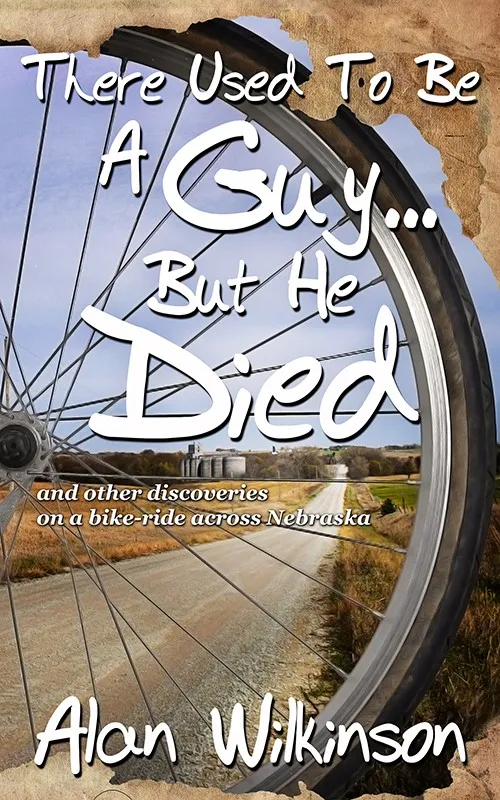
There Used to Be a Guy… But He Died
and other discoveries on a bike-ride across Nebraska
The sun blazes down on Main Street. The little old feller sitting outside the barber-shop hears a dry rhythmic squeaking and sees the stranger riding into town. On a bicycle.
The stranger lowers himself to the ground, grimacing. The old feller pauses, cigarette between his lips and a match in his hand. He pushes his hat back on his head, wondering what kinda darned fool is out in this heat.
The stranger asks, ‘Any idea where I can get this fixed?’
The old feller strikes the match on his boot-heel. Lights his cigarette. ‘We-ell,’ he says, and inhales deeply, ‘there used to be a feller.’ He lets the smoke out in a long slow plume. ‘But he died.’
For British travel writer Alan Wilkinson there’s only one way to get to know a place, and that’s the hard way. Here the author of The Red House On The Niobrara recalls his 630-mile trip across Nebraska on a borrowed bicycle. Heading west from the banks of the Missouri river, he makes for the Wyoming line and the state’s highest point, 5,426 feet above sea level. It’s an elemental experience as he’s broiled by a September heatwave, stopped dead in his tracks by a 55 mph wind, scarified by flying dirt, then chased by dogs and rescued by a cowboy. Along the way he considers the history of this Great Plains state, and his reasons for being drawn to it.
Extract
An extract from There Used to Be a Guy… But He Died
1
There are two things worth knowing about Nebraska. One is its flatness, which is well documented in the literature of the Great Plains. The other is its emptiness, which is a part of Western folklore. Tell the average American you’re going to visit the place and they’ll ask you why, for God’s sake: ‘There’s nothing out there, just mile after mile of cornfields and cattle.’
The writer Willa Cather, who grew up in the Cornhusker state in the 1880s, expressed it rather better. Describing that country as seen through the eyes of a young boy, an emigrant looking out of a train window, she wrote: There was nothing but land: not a country at all, but the material out of which countries are made . . . The only thing very noticeable about Nebraska was that it was still, all day long, Nebraska.
My fascination with Nebraska started when I read My Antonia, from which the words above are quoted. Later, I was directed towards the rather earthier work of Mari Sandoz, the daughter of a Swiss immigrant who settled in the dry and empty Sandhills in the mid-1880s.
I first visited the area in 1991, driving west from St Joseph, Missouri, along the Oregon trail, and again in ’93, when I attended a conference on Cather’s work at Hastings, in south central Nebraska. I think that’s where I became frustrated with my scant knowledge of the state, and was infused with a desire to know it better. Some while later, back in England, I was poring over my Rand McNally road atlas when something I was well aware of, but tended to overlook, struck me quite forcibly. As a Plains state, Nebraska is pretty flat. It is also laid on the tilt. On the banks of the Missouri River you’re a mere 840 feet above sea-level. At the far end, the Wyoming line, you’re a mile high, and then some: 5,426 feet, to be precise. It looked like the kind of journey you could do on a bicycle, if you were crazy enough. All I had to do was get hold of one and I’d be on my way.
I wrote to the Nebraska Department of Roads and Transport’s Bicycle Co-ordinator at his office in Lincoln. I told him what I had in mind, and then threw in a story which everybody in my family believes, that our great-great uncle, John Wiltshire, captained the ship that brought Buffalo Bill’s Wild West Show to England in 1887. I think that’s what swung it. The Co-ordinator directed me to an outfit in Lincoln called Bike Pedallers, Inc., proprietor Rich Rodenburg. When I wrote to him, it seemed that he liked my story too. He told me to call by when I hit town.
Thus it was that twelve hours after getting off a plane at Omaha I was wobbling up 33rd Street in Lincoln on a shiny new 21-speed Diamond Back Lakeside. ‘Nebraska’s pretty flat,’ Rich told me. ‘You won’t hardly need the gears.’ After I’d tried it out and he’d made a few minor adjustments he said, ‘So, you’re related to Buffalo Bill, huh?’
‘That’s right,’ I told him, without batting an eyelid.
Then he sold me a couple of items I didn’t think I needed, but felt I ought to have for goodwill - a helmet, a mirror and suchlike. And, for another couple of dollars, he filled the tyres with green slime - proprietary name Gunk. ‘You get a puncture, it reacts with the air and seals itself,’ he told me. I felt better about that, and took out my wallet.
‘Well, okay,’ he said, handing me my change. ‘Fetch the bike back in good condition and we’ll call it a loan.’
2
It was appropriate that I should set out on Labor Day: the trip was going to be hard work. My starting-point, the lowest spot in Nebraska, was to be down in the far south-eastern corner of the state, a mile or two below the little town of Rulo and over a hundred miles from Lincoln, where I was staying with friends. They offered to drive me as far as Auburn, in Nemaha County, leaving me a thirty- or forty-mile ride down to the river.
We put the bike in the trunk, piled in my two panniers, the tent, my airbed and boots, then the water-bottles, and drove east. My daughter came with us. Taking my thirteen-year-old to Nebraska was a part of the deal I’d struck with my wife. You can’t leave a working mother with three children while you swan off to live out your dreams - at least, not in our house you couldn’t. So Julia would stay with our friends and attend Junior High in Lincoln for a month, and I would phone her every night. Later, she would tell me how bemused she felt as I rode off in the hot sun after we’d sat in a café drinking iced tea and speculating as to whether I would dare to give up should the physical strain, the heat, or the loneliness, prove too much for me. But at the time she gave me the briefest of hugs and I was away.
Having to head east and south for most of the day when I was embarking on an epic adventure to the west was a pain only slightly alleviated by the fact that the wind was with me. Sailing down that first long descent out of Auburn, struggling to find a gear in which I could feel any kind of traction, I realised that I was going to worry about conditions all the way. How could I enjoy this following wind knowing that unless it turned around it would be in my face tomorrow? How could I relish the downhill when the uphill was rearing its head in the near distance?
I couldn’t. Even if I wanted to, there wouldn’t have been time. I reached the bottom of the hill in seconds flat and saw in the landscape in front of me a succession of rolling waves leading to a far horizon. I consoled myself with the thought that it was only going to be like this for the first 300 miles.
I dropped down through the gears and started leaning on the pedals. Sweat ran down my face and stung my eyes. It was only mid-morning but the heat was fierce. A hundred yards and I was within two notches of bottom gear on what was hardly a precipitous climb. My breathing was laboured and my legs hurt. I was swaying across the shoulder and onto the highway. I wanted to stop, but didn’t dare. What if they were still watching, back at the café?
My first target was Brownville, where I would get off Highway 2 and head south on a county road towards Rulo. Approaching the little town in a state of near-total exhaustion, I saw an invitingly empty road sweeping downhill onto a broad stretch of smoothly paved highway. Letting go of the brakes, I flew down, sped along the level and coasted up a slight rise to a large iron bridge, coming to rest beside a sign: Missouri River. And there indeed was the great waterway, the tangle of trees and underbrush along its banks. Only one problem: I wasn’t supposed to be there, not for another thirty-some miles.
Across the road, a high-school kid was getting into a pick-up truck. ‘Excuse me,’ I called over. ‘Where’s the road to Falls City?’
He didn’t laugh out loud, but his face creased into a knowing sort of grin. ‘Back at the top of that hill,’ he said. ‘Guess you didn’t see the sign, huh?’
Heading south now, I still had the wind on my back. The hills were gentler and I made good time, perhaps fifteen miles an hour. Even so I found my energies coming and going in waves. On the steeper inclines I felt nauseous. On level going I felt ready to cycle on around the world. I started on the Dextrose tablets my younger daughter had bought me as a going-away present.
My hosts had told me I would see three crops in this part of Nebraska: corn, soya-beans and milo. And that’s what I saw, mile after mile after mile, until I hit Falls City in Richardson County around three. I was tired and hungry, dreaming of iced tea and pie. But this was Labor Day, and everything was closed.
A few miles further on I stopped, laid my bike in the long grass beside the road, and sat down. Looking behind me, I saw that I had climbed two long but not particularly steep hills in succession. I was seriously worried at how tired I felt. Sure, I’d come forty miles, but I was going to have to do fifty and more most days, and it wasn’t always going to be as easy as this, the wind behind me and the sun on my back. Then I tried to remember how long it was since I’d last cycled this far in one stretch. Fifteen years was the answer – a holiday in Ireland’s Wicklow Hills. I was thirty then. I got up from the grassy bank and pushed myself forward. Who ever said this was going to be easy?
I arrived at Rulo (pop. 191) around four. On the bridge across the Missouri was a sign recording the fact that Lewis and Clark had made camp around there in July 1804. I should have been excited to think I was treading in the footsteps of the great explorers, and in other circumstances I’m sure I would have been. But right now I couldn’t have cared less. My skin was sticky with sweat and dust, the tops of my ears, my nose and forearms were scalded.
Across the road an unmade track led down to the riverside. Almost as many vehicles were heading that way as were crossing the bridge connecting Nebraska with Missouri. I rode the rutted mud, over deep tracks left by Caterpillars working on a pipeline. Four-wheel drives and pick-ups were parked untidily in the shade of tall, gangling trees whose limbs splayed out at improbable angles.
The great waterway was broad and swollen, a murky heaving grey, more like a sea than a river. Despite the 85-degree heat there was a dankness about the atmosphere. A surly man stood at the bottom of a crumbling concrete ramp beside a fibre-glass hull and watched as his wife backed a rusting truck down the slope towards him. She got it wrong, missing the hook-up, and he cussed loudly. She tried again, failed, and his son waddled up to help her.
Just then, the air was split by the roar of outboard motors. Young men in life-jackets, their arms bare, stood astride screaming machines, cutting swathes of white water as they bucked and turned, bouncing off the waves they’d created, leaping into the air to come down – smack! – on the angry water. As I stood there I thought of Lewis and Clark’s men rowing and hauling their laden craft north and then west, the men tramping the shores with ropes over their broad shoulders, wading through marshes and thickets long since washed away by a river now tamed by the Corps of Engineers.
Finally, the family on the ramp got the boat hooked up to the truck, the man now at the wheel, the wife passing him a lighted cigarette. I walked down to where the waves licked at the slimy concrete ramp, squatted down and washed my hands.
I hurried back to my bike and pointed it west. But what of my ‘lowest point’? The Complete Roadside Nebraska – a two-and-a-half-pound weight of information on every settlement and feature in the entire state, which my hosts had given me – told of an unspecified spot a couple of miles downstream from here. But how far would the mighty Missouri be likely to fall in those two miles? A couple of feet?
I’d had enough low spots for one day. And I’d symbolically bathed in the river that Lewis and Clark navigated all those years ago. That would have to do.
The road back to Falls City seemed far more uphill than down, and the day’s final nine miles took the best part of an hour. I’d done fifty-seven in total. According to my plan I should now be looking for a camping ground. But I hadn’t another yard in me. I made it to the red light, turned down Main Street, and fled to the welcoming shelter of the first motel I saw. $23 plus tax.
I was in bed by a little after eight, asleep soon after, and never woke up once.