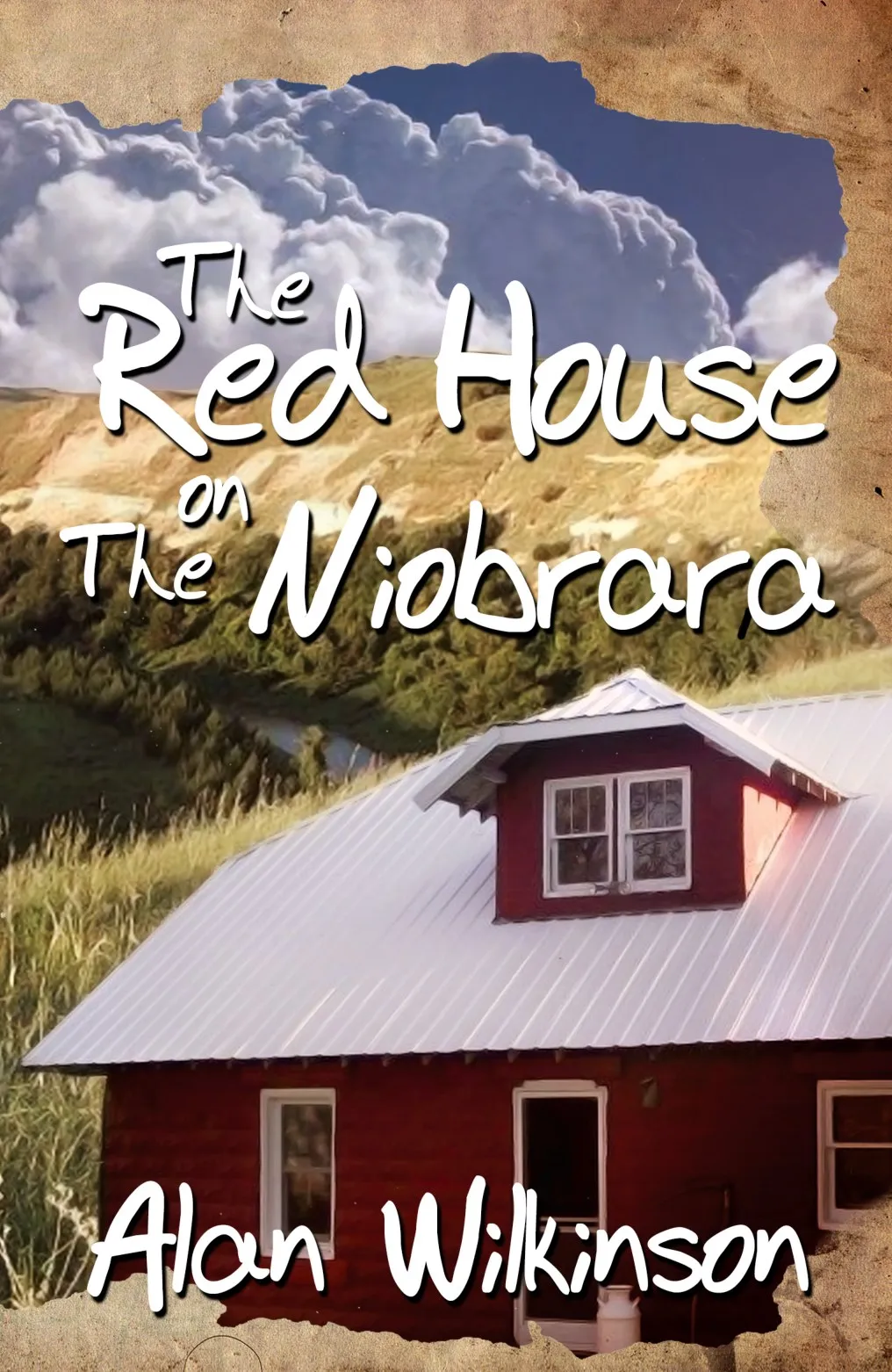
The Red House on the Niobrara
Fascinated by the life and work of Mari Sandoz (author of Crazy Horse, Cheyenne Autumn, Old Jules), British writer Alan Wilkinson had visited her home state a dozen times over twenty years. He’d read a great deal about the early days on the Nebraska frontier, but wanted to know more. What would it really, truly, be like to live on the naked Plains for a season? Could he still get a sense of what those pioneers went through, a century ago?
There was only one way to find out - and when a ranching couple offered him the use of a hundred-year-old hunting lodge, built by settlers on the banks of the Niobrara river, he shook hands on the deal before they could change their minds.
Sure there were holes in the roof, and snakes in the basement - but he wanted an authentic frontier experience, right? The week after he moved in he was hit by an April blizzard. A month later his road was washed away by a thunderstorm. Determined to act out a part of the pioneer experience, he collected a pile of cow-chips and planted a garden. The first was wiped out by hailstones, the second by grasshoppers.
He spent the spring and summer hiking the hills, exploring the riverside and investigating the history of the Danish immigrants who first settled this little plot, hardy folk who graduated from a dug-out to a soddy, then built the little red house that was now his home. For relaxation he socialized with local ranchers, hit the bars and the rodeo, rode the range with Department of Agriculture surveyors, worked on the spring round-up and helped cut the hay.
In between he re-considered the life and work of his heroine, Mari Sandoz, re-visiting what remains of her home and camping out at her grave-site. This is a reflective work, a lyrical appreciation of place that remains firmly rooted in the author’s elemental relationship with a unique landscape. It is a narrative populated by a cast of genuine western characters, living and dead.
‘A wonderfully evocative and complex part memoir, part travelogue, and part landscape description.’ Richard W Etulain, western historian.
‘As with the best travel writing, a visitor has held up a mirror to a place I love and shown it to us more clearly than we see it ourselves.’ Linda Hasselstrom, rancher, South Dakota Poet of Merit.
“As with the best travel writing, a visitor has held up a mirror to a place I love and shown it to us more clearly than we see it ourselves.”
“Wilkinson has completely captured not only the feel of the land and its people, but his readers as well - who are forever in his debt.”
“A wonderfully evocative and complex part memoir, part travelogue, and part landscape description.”
Extract
An extract from The Red House on the Niobrara
I really wanted to start with Buffalo Bill, even though I can hear Mari Sandoz snorting her disapproval at the very mention of his name. She never thought much of him. But that’s a great story, the one about my great-great-uncle. I mean the ship’s captain, back in 1887, who ferried the old scout and his troupe of showmen, sharpshooters and Indians across the Atlantic on the State of Nebraska and introduced into my family the precious Wild West souvenirs that so fascinated me as a five-year-old. It always seemed to me that if I was going to tell a story about my time here on the Great Plains, that would be the place to begin, with Captain Wiltshire. Trouble is, it turned out that just because a story’s been around for a hundred years it doesn’t mean it’s true.
So, if I’m going to explain what persuaded a sixty-two-year-old jobbing writer to spend six months alone in a semi-derelict hunting lodge in the remote and forbidding Sandhills of western Nebraska I’d better start with an earlier escapade, and a pretty foolhardy one at that. I mean the time I set off from the banks of the Missouri river on a borrowed bicycle, and pedalled west in my sandals until I was able to convince myself that the flickering whiteness I thought I saw on the far horizon might just be the Rocky Mountains.
Rulo to Kimball, and then some - the whole length of Nebraska, from its lowest point, 840 feet above sea level, to its highest, 5,424, just to get a sense of the place. It wasn’t much more than 600 miles, but it was two weeks of hard going in a fierce September heatwave. I was on the last leg, shovelling breakfast down my throat in a tiny ‘Mom and Pop’ joint at Bushnell (population 124), the point where I would finally leave Highway 30 and make my way across country on gravelled roads to Promontory Point, over a mile above sea level.
I can still see that cowboy at the next table, rubbing a calloused hand over his chin and looking out across the dusty yard at an endless vista of low hills, their bunch-grass overcoat ruffled by a brisk south-easterly. ‘What exactly you say you’re doin’ out here?’ he asked.
‘Well,’ I said, ‘I’m pedalling my bike across Nebraska, east to west.’ I wanted to tell him about my great-great uncle, about my interest in Mari Sandoz, biographer of Crazy Horse, who’d grown up just north of here but got the hell out as soon as she could, and the way she chose to paint it, years later, from the safety of the east: majestic, beautiful, haunting, calling to her from a thousand miles away. But out west you don’t generally break into poetic abstraction unless you’ve earned the right, and that’s the province of old-timers, drunks, or bona fide oddballs.
While I was thinking the cowboy lit a cigarette and said, ‘Now what in the name o’ tarnation made you do a damn fool thing like that?’ He grinned at me through a veil of blue smoke. ‘Lose a bet, did ya?’
It wasn’t the first time I’d had to answer such questions in diners and bars along the way. By now I’d honed my response down to a single line and couched it in western idiom. ‘Guess I wanted to see what Nebraska’s really like,’ I told him.
He stared out the window some more, watching the wind tug at the yellowing leaves of the old cottonwood against which I’d propped my bicycle. Then he turned towards me. ‘We-ell, I can tell you what it’s like, feller.’ He drew on his cigarette, and exhaled slowly. ‘It’s desolate.’ Then he repeated it, nice and slow, just in case I hadn’t caught it. ‘De-so-late.’
I’d used the very same word in my diary two days previously after I rode out of Ogallala and into a 55 mph head-wind, when a level sheet of cloud spread over the landscape like a huge grey tablecloth, compressing the space between earth and sky. The dirt was flying, the visibility dropped to fifty yards and I went down through the gears, click click click, until I just ground to a halt.
It wasn’t the first time I’d felt like giving up. If I’m honest, there were moments along the undulations of the Republican river valley with its three, four, five hills per mile, later beside the railroad tracks that follow the Platte, when the temperature hit 97 and all I had to aim at was the next grain elevator hovering above a glassy horizon. Times like that I’d thought hard about giving up – except that there was nobody out there into whose arms a guy could surrender. No way back. The only option was to keep heading west.
I finished my breakfast in the little diner there under the cottonwood tree, said goodbye to the cowboy, got astride my bike and set off towards the sign on the highway bridge. PAVEMENT ENDS. Just fifteen miles on the dirt and my journey, which had started ten days earlier, on Labor Day, would be over. I headed south, then turned west, then south again, beside huge fields of sunflowers and bleached wheat stubble. Along the way I remember pausing to investigate an abandoned one-room schoolhouse, then braking to watch a herd of white-tail deer, twenty strong, arc across the road and slide from view, swiftly, silently, the way water sinks into sand. And all the time I kept thinking about what that guy had said, how he’d dismissed the entire area in a single word. I knew he was wrong. Had to be.
Even as I pedalled back to town that night, my quest completed, my name added to the register they keep in a tin box out at the highest point, a place barely distinguishable from any other in a huge expanse of grassland, I knew I’d have to come back and take another look. Had to find this magical Nebraska that Mari Sandoz writes about.